

Since the 5th of October 2026, turning a house in Coatham ward into a small HMO needs planning permission. The Direction was first made on the 25th of September 2025 and confirmed by the Council on the 11th of June 2026.
| Council | Control | In force |
|---|---|---|
| Redcar and Cleveland | Article 4 Direction, HMOs | 5 October 2026 |
Plenty of agents will get caught here, and not because they ignored the news. They will get caught because they checked the wrong thing. This is a planning control, not a licensing scheme, and a property can be fully licensed and still be in breach of it.
What Is Changing in Coatham?
Normally, changing a house from a family home into a small HMO is permitted development. You do not apply for anything.
An Article 4 Direction removes that permission. In the council's wording, the Direction covers a change of use from Class C3, dwellinghouses, to Class C4, houses in multiple occupation, being development comprised within Class L(b) of Part 3 of Schedule 2 of the General Permitted Development Order 2015.
In plain terms: in Coatham, that conversion is now a planning application.
Which Wards Are Covered?
The electoral ward of Coatham. One ward, not the borough.
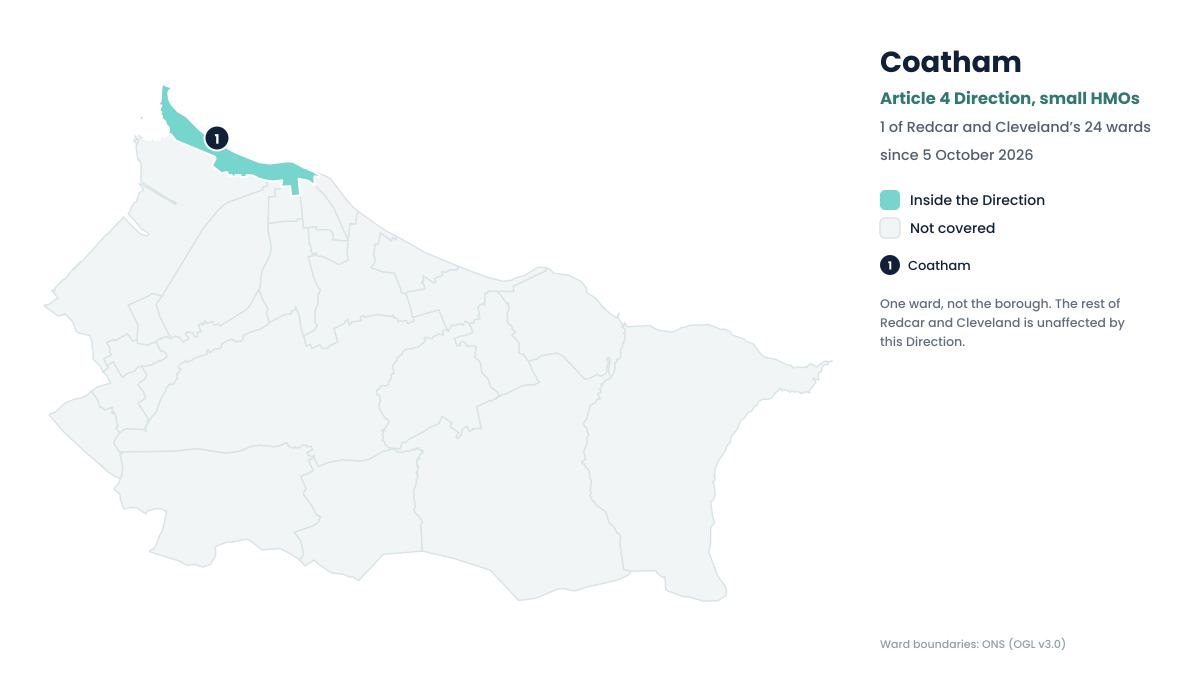
Worth saying twice, because Article 4 Directions elsewhere are often far wider. North Lincolnshire's covers every ward in Scunthorpe. This one stops at Coatham. Ward boundaries rarely follow the lines people use in conversation, so check an address before advising anybody on it.
Which Properties Are Affected?
A house converted into a small HMO, for three to six unrelated occupiers, from the 5th of October 2026 onwards. That is the whole of it.
What Is Not Affected
HMOs that already existed lawfully. An Article 4 Direction removes a right going forward. It does not undo a change of use already lawfully carried out before the 5th of October.
The reverse direction. The council has withdrawn Class L(b), which is C3 to C4. Turning an HMO back into a single dwelling is untouched.
Large HMOs. Seven or more occupiers always needed planning permission.
The first of those is where people come unstuck. The use is lawful, but it has to be proved later, to an officer who was not there. The evidence is ordinary: tenancy agreements, council tax records, licensing correspondence, utility accounts in several names. Most agents have it somewhere. Few have it gathered per property, which is the difference between a five-minute answer and a month of digging.
Licensing and Planning Are Two Different Questions
A licence says the way a property is occupied is acceptable. Planning says whether the building is allowed to be an HMO at all.
They are issued by different teams, under different legislation, and they fail independently. A property can be correctly licensed and still be in breach of the Direction, and nothing about holding the licence will help.
Why This Matters
A breach of planning control is not in itself a criminal offence. The council serves an enforcement notice, and failing to comply with one is an offence under section 179 of the Town and Country Planning Act 1990, carrying a fine with no upper limit. When the court sets that fine it must take into account any financial benefit from the breach, which for an unauthorised HMO means the rent.
The offence is not limited to the owner. It also catches a person who has control of or an interest in the land and allows the use to continue, so a managing agent's position depends on their contract.
And the window is longer than most people remember. Enforcement for this kind of breach can be taken within ten years. It was four until April 2024.
There is a commercial version of the same problem. A property that cannot lawfully be used as an HMO is a different property at refinance and at sale.
What Landlords Should Do Now
1. Identify which of your addresses are in Coatham ward. Not Redcar. The ward. 2. Establish what each is being used as today: small HMO, large HMO, or single let. 3. For small HMOs that pre-date the 5th of October, gather the evidence of lawful use now, while the people who remember still work there. 4. For anything in the pipeline, a purchase or a conversion, assume planning permission is needed and price it in before exchange. 5. Track licensing and planning separately. They answer different questions and they fail independently.
Why Landlords Get This Wrong
*"It's licensed, so it's fine."* Two different regimes, two different answers, and the licence does not cover the planning question.
*"It's already an HMO, so this doesn't apply."* Correct, which is exactly why the evidence matters. The protection is real but it has to be demonstrated.
*"We'll deal with it if someone asks."* Someone has ten years to ask.
How Yuno Can Help
We hold the licensing and planning position for every property in a portfolio and tell you when one of them changes.
For Coatham that means knowing which addresses sit inside the ward, which already operate as HMOs and whether the evidence of lawful use is on file, and whether anything being bought there needs permission first. You keep the landlord relationship. We do the checking and the paperwork.
*Source: Redcar and Cleveland Borough Council, Article 4 Direction - HMOs. All dates and the wording of the Direction are taken from the council's own page.*