

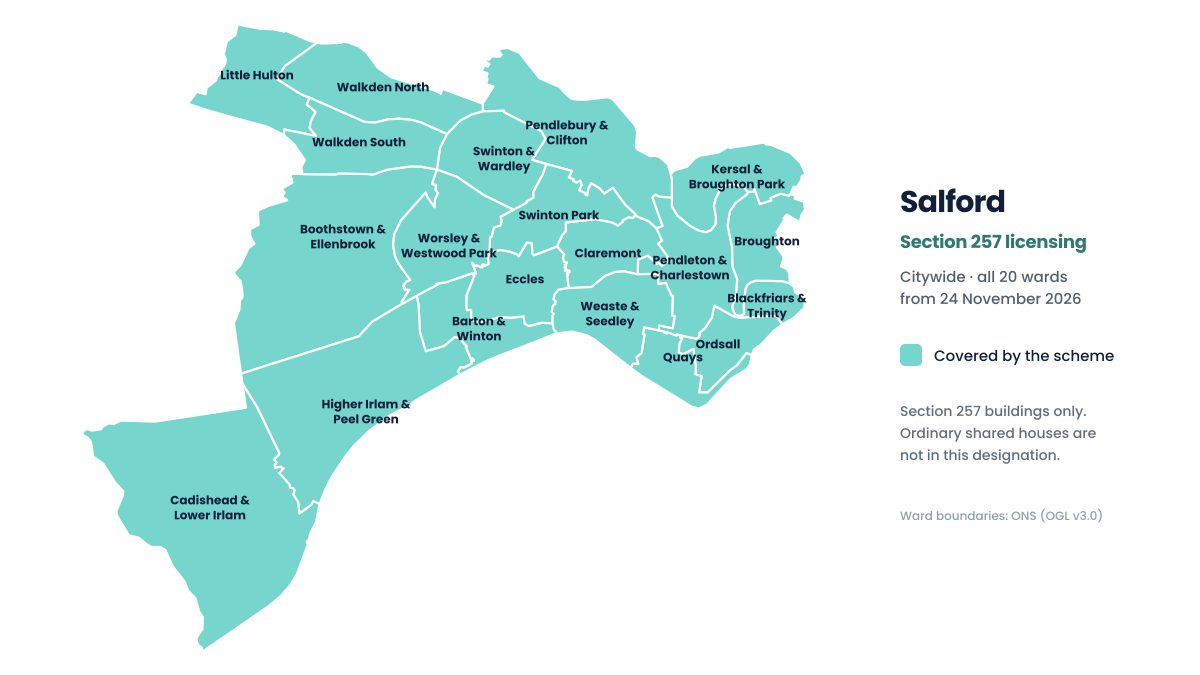
From 24 November 2026, every building in Salford that meets the section 257 definition needs a licence. The scheme covers the whole city and runs for five years, with all licences ending on 24 November 2031 (as per the council's website).
| Council | Scheme | Starts |
|---|---|---|
| Salford | Additional HMO, section 257 only | 24 November 2026 |
This is an unusual scheme, and the unusual part is what it leaves out. It is not additional licensing for shared houses. It is additional licensing for one specific kind of building, applied across every street in Salford.
What Is Changing in Salford?
Salford has designated a citywide Additional HMO Licensing scheme that applies only to section 257 HMOs.
Most additional licensing schemes target small shared houses, the three and four person HMOs that fall outside mandatory licensing. Salford already ran one of those, designated in 2021, which ended on 19 July 2026 and cannot be renewed.
The new scheme is a different animal. It leaves shared houses alone and goes after converted blocks of flats.
Which Properties Are Affected?
A section 257 HMO, in the council's own description, is typically a building that:
- has been converted into self-contained flats
- where the conversion does not fully comply with the relevant Building Regulations standard
- and where fewer than two thirds of the flats are owner occupied
All three conditions have to be met. The second one is what catches people.
A building converted before 1991, or converted later without full compliance with the Building Regulations in force at the time, can be a section 257 HMO even though every flat in it is self-contained, has its own front door, its own kitchen and its own bathroom. Nothing about it looks like a house in multiple occupation, and the tenants would be baffled to hear it called one.
That is precisely why these buildings go unlicensed. The owner is not being careless. The building does not look like the thing the rules are named after.
What Is Not Affected
Buildings where two thirds or more of the flats are owner occupied. These do not meet the owner-occupation test, so they are not section 257 HMOs.
Conversions that fully met the Building Regulations standard applicable at the time of conversion.
Ordinary shared houses. This scheme does not cover them. Mandatory licensing still applies where it applies.
A statutory exemption may also remove a property from the scheme, and those are worth checking per building rather than assuming.
Why This Matters
Operating a licensable property without a licence is a criminal offence. The council sets out the consequences plainly: prosecution, a financial penalty of up to 40,000 pounds as an alternative to prosecution, a rent repayment order, and action by the council to take over management of the property. Failing to comply with a licence condition is a separate offence.
There is also a deadline inside the deadline. Accredited landlords qualify for a discounted fee, but both the landlord and the property must be accredited before 24 November 2026. Accreditation takes time to arrange, so the practical cut-off for that discount is earlier than the date on the scheme.
And one detail worth putting in your own records rather than trusting to memory: every licence under this scheme ends on 24 November 2031 (as per the council's website), whenever it was granted. A licence issued in 2029 does not run for five years. It runs until the scheme ends.
What Landlords Should Do Now
1. Identify every converted block you manage in Salford. Self-contained flats, one building, one freehold. 2. For each one, work through the three conditions. Converted into self-contained flats, conversion not fully compliant with the Building Regulations standard, fewer than two thirds owner occupied. 3. Where the conversion date or the standard is unclear, find out. This is usually a building control search or a surveyor, and it is the step people skip. 4. If you want the accredited discount, start now. Both the landlord and the property have to be accredited before 24 November 2026. 5. Diarise 24 November 2031 for every licence, not five years from whenever it was granted.
Why Landlords Get This Wrong
*"They're self-contained flats, so it isn't an HMO."*
Self-contained is not the test. The test is whether the conversion met the Building Regulations standard and how many flats are owner occupied.
*"The building has been like this for thirty years."*
That is often exactly why it qualifies. Older conversions are the ones least likely to meet the standard.
*"We only manage two flats in the block."*
Licensing attaches to the building, not the flat. The question of who holds the licence in a block with several owners is one worth resolving early rather than on the day.
How Yuno Can Help
Section 257 is the part of licensing that gets missed most often, because the buildings do not look like HMOs and the test is technical rather than visual.
We work through a portfolio building by building, establish which blocks meet the definition, chase down the conversion history where it is unclear, and handle the applications. You keep the landlord relationship. We do the checking and the paperwork.
*Source: Salford City Council, Section 257 additional HMO licensing designation. Fees vary by the number of flats in the building and are published on the council's page. Apply at the council's HMO licence page, or contact landlord.licensing@salford.gov.uk, 0161 793 3344.*